


The full-scale 1.5-mgd Hyperion Advanced Water Purification Facility is a collaboration between LA Sanitation & Environment and the Los Angeles Department of Water and Power. The facility features climate-informed sustainability practices such as advanced treated recycled water from the Hyperion Water Reclamation Plant (HWRP) to use at the Los Angeles International Airport, including cooling tower make-up water, toilet flushing, irrigation and other non-potable uses. The recycled water will also be used at HWRP to offset potable water demands in its industrial water system as well as provide recycled water to existing internal infrastructure. (Nathan Padilla Photography)
Today’s Climate-Adaptive Approach Can Help Lower Tomorrow’s Borrowing Costs
For utilities, climate risk is no longer a concern for tomorrow—it’s already increasing the cost of infrastructure today.
Recent research (“Research puts numbers on wildfire risk and muni borrowing costs,” The Bond Buyer, April 24, 2026) shows that utilities exposed to hazards such as wildfire and sea-level rise are experiencing higher borrowing costs as investors price in climate-related risk.
This “exposure premium” can translate into interest-rate increases, challenges with insurability and creditworthiness, and raising the cost of capital across infrastructure programs.
The Climate Risks by Project Type chart (see Table 1) shows a range of climate hazards and infrastructure combinations that can pose challenges across a utility’s capital program. The seven basic climate challenges—extreme heat, extreme cold, extreme storms, sea-level rise, riverine flooding, storm surge and extreme precipitation—represent combinations of assets and hazards (or “project types”) that lack comprehensive guidance and have a high potential for impact. These deal with building mechanical, electrical equipment; power supply; wet walls and associated structural components; stormwater and wastewater outfalls; wastewater conveyance; and chemical storage facilities.
Some project-type hazards may feature the same assets yet face multiple hazards concurrently.
The chart in Table 1 makes it clear that climate risk often is more than a single, isolated threat. That’s why identifying exposure early matters not only for technical design, but also for the financial decisions that shape infrastructure investment.
The bottom line: Delaying adaptation can create a compounding cycle. The formula is simple: higher risk = higher borrowing costs = deferred investment = even higher risk = increasing costs.
Given that summation, the solution becomes evident: To lower exposure premiums, utilities must take the long view: a broader, results-driven approach that integrates climate resilience into infrastructure planning and design. This sustainable and financially responsible strategy also can drive long-term system performance while reducing exposure to rising capital costs.
Reactive or Proactive?
For many utilities, the question isn’t whether they’re already paying for climate risk; it’s whether that cost shows up as a reactive expense or a proactive investment.
Historically, climate adaptation has been treated as a planning exercise that frames it as a problem to solve tomorrow. As more insurers require adaptation measures or simply deny coverage, that approach is already too late.
To flip the script and bring climate adaptation to the forefront, utilities need not only a starting point (Table 1), but a practical method to evaluate such risk in a way that supports planning, design and investment decisions.
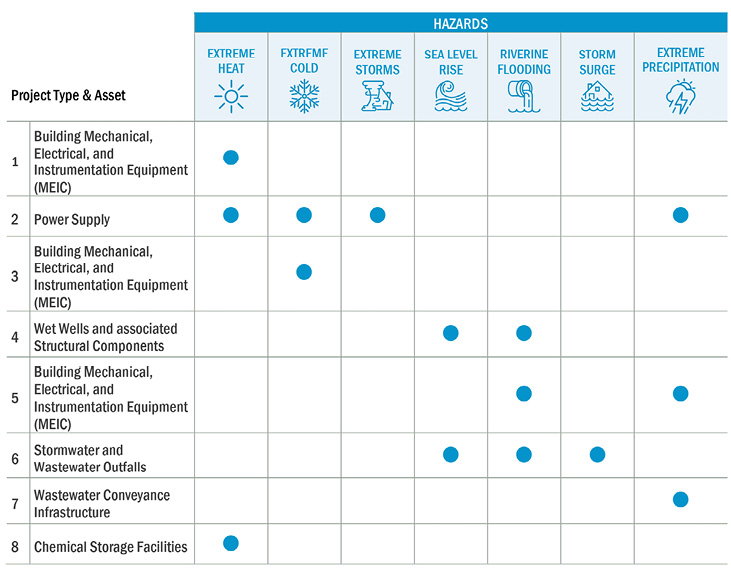
Table 1. Climate risks by project type help utilities identify which assets may face multiple climate hazards and where resilience-focused planning and design guidance may be needed based on a review of existing available guidance. (Water Utility Climate Alliance)
A climate risk-assessment process (see Figure 1) offers a practical framework for moving from broad climate-hazard awareness to a more asset-specific understanding of vulnerability, consequence and priority action. The approach involves the following:
1. Hazard Exposure: Consider hazard characteristics and exposure to hazards by using existing climate-threat and infrastructure-asset data. Taking a more holistic planning perspective, infrastructure assets can include transportation, emergency, utility, natural, social and cultural infrastructure.
2. Sensitivity Analysis: Consider how exposed assets may be affected by these hazards based on asset characteristics.
3. Adaptive Capacity Documentation: Document abilities to adapt to hazards and reduce potential impacts.
4. Consequence Analysis: Identify potential impacts based on the combination of hazard exposure, sensitivity and adaptive capacity.
5. Development of a Risk Matrix: Identify “hotspots,” and document and prioritize risks for vulnerable assets across
your utility.
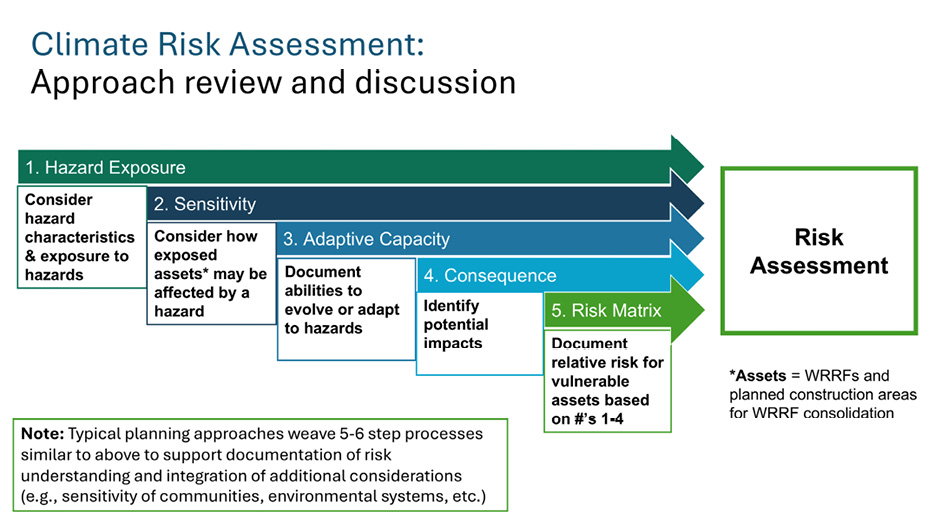
Figure 1. A climate risk-assessment process helps utilities move from hazard exposure to prioritized action for vulnerable infrastructure assets. (Brown and Caldwell)
After climate risks are identified and prioritized, utilities can move from documenting vulnerability to designing for resilience. From there, climate considerations can be embedded into core engineering decisions now, shifting future planning into today’s design strategy.
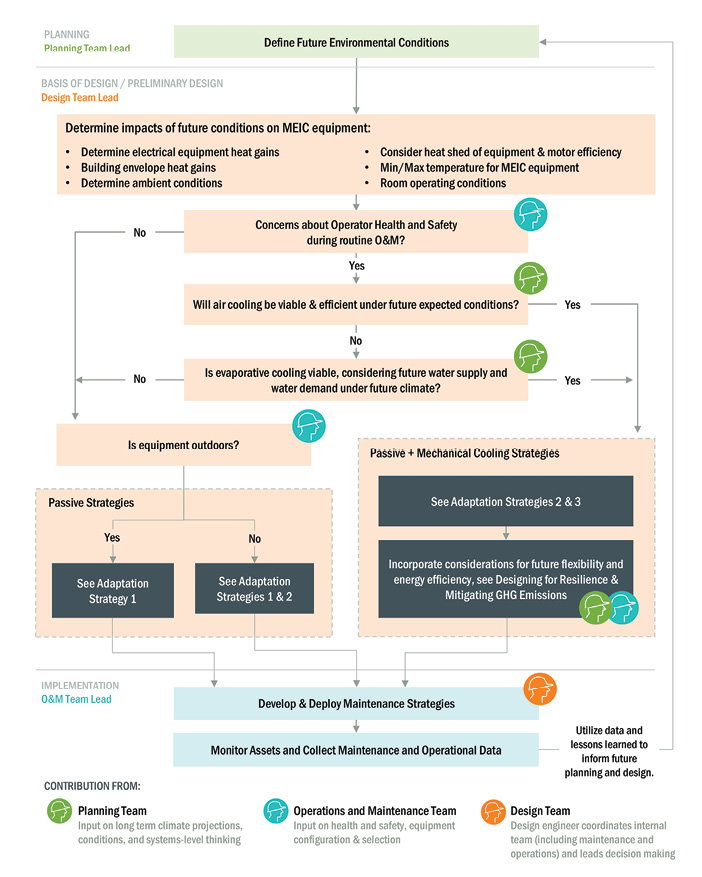
WUCA’s process flow illustrates how future environmental conditions can inform asset-specific planning, design and operations strategies. (Water Utility Climate Alliance)
The following are a few real-world examples that illustrate climate-informed design today:
Flooding (sea-level rise and pluvial/rainfall flooding)
• Elevate electrical and other sensitive equipment above current or projected flood levels
• Siting to higher ground level or higher grading for new site development
• Select corrosion-resistant materials such as pipe and fittings that can withstand high salinity or air-entrained, low-permeability concrete with corrosion-resistant reinforcing steel
Wildfire
• Use stucco or other noncombustible exterior materials
• Specify fire-resistant building materials and defensible space buffers
• Eliminate eave vents where appropriate to reduce ember intrusion
Extreme heat
• Consider the orientation of a building to minimize solar exposure and heat gains
• Incorporate passive and mechanical cooling strategies for critical facilities and safe operating conditions for staff such as a sun-shield structure or limiting occupancy and adjusting work schedules
Extreme cold
• Weatherize equipment for cold resistance by using appropriate lubricants as well as insulating and heat-tracing piping and equipment
• Look for heat-recovery opportunities from electrical equipment such as splitting a duct so it can capture the heat generated by variable-frequency drives and use it in other equipment rooms during colder months and divert it outdoors during warmer months
Integrating Climate-Aware Design Into Capital Programs
These measures are valuable on their own but achieve maximum impact when integrated into broader capital projects. These two case studies show what it looks like in practice.
Managing Extreme Wet-Weather Flows Through Adaptive Wastewater Infrastructure
In one Midwestern wastewater system, more frequent high-intensity rainfall increased wet-weather flows, overwhelmed lift-station capacity and contributed to sewer backups during major storm events. Because downstream sewer capacity limited the ability to simply add more pumping, the utility used offline storage as a climate-adaptive design strategy.
Constructed adjacent to an existing lift station, the storage basin helped the utility address an immediate service risk while building flexibility for future precipitation, regulatory and capacity conditions. The design incorporated three resilience-focused features:
1. Sizing the basin to manage excess wet-weather flow. This increased protection against basement flooding during events beyond the original design basis.
2. Preserving space for future storage expansion, giving the utility flexibility to accommodate increasing precipitation, changing regulations or future service needs.
3. Incorporating features that could support eventual pump-station replacement, allowing the project to solve an immediate operational challenge while positioning the system for a more-resilient long-term upgrade.
The Water Utility Climate Alliance (WUCA) Guidance offers a structured catalog of adaptation strategies organized by climate hazard, including visuals for key decision questions to help identify which strategies to pursue. (Water Utility Climate Alliance)
Sewer Heat Recovery and Low-Carbon Infrastructure Reuse
In the Pacific Northwest, an urban wastewater utility partnered with private development to recover thermal energy from wastewater and use it to help heat buildings. The resulting design showcases how existing infrastructure can be repurposed to lower carbon emissions and support sustainable urban development.
By using existing sewer infrastructure as a steady heat source, the project reduced reliance on conventional energy sources while demonstrating how wastewater assets can support broader resilience, decarbonization and community energy goals.
The example illustrates that climate-adaptive design isn’t limited to hardening assets—it also can mean repurposing existing systems to create new value under changing conditions.
While there’s no way to eliminate uncertainty completely, climate-aware designs such as these two examples consider infrastructure performance under a range of future conditions, not just historical norms.
As a result, adaptation becomes part of the capital program itself, rather than a separate or deferred effort. This guiding “north star” points to three outcomes:
1. Stronger resilience: Improve the system’s ability to withstand future conditions.
2. Better reliability and continuity of service: Reduce the likelihood of disruptions or asset failure.
3. Greater cost savings: Demonstrate reduced risk to capital markets and deliver measurable financial benefits.
From Uncertainty to Actionable Decisions
A common barrier for utilities is knowing how to move from understanding risk to implementation. Reference materials such as the Water Utility Climate Alliance (WUCA) Guidance can help by providing a structured catalog of adaptation strategies organized by climate hazard (e.g., heat, flooding, wildfire), asset or system type, and project phase (planning, design or operations).
Key recommendations include equipment selection, structural reinforcement, floodproofing, green infrastructure, and robust control systems to ensure reliable service and long-term sustainability.
The WUCA process flow below illustrates how broad climate concerns can become actionable planning, design and operations decisions.
WUCA is one example among several resources that can benefit utilities. Publicly available guidelines from agencies such as the New York City Mayor’s Office of Climate and Environmental Justice, Philadelphia Water Department, and the National Oceanic and Atmospheric Administration also can provide useful reference points.
Rather than providing a single answer for every utility, these resources are valuable because they empower teams to ask better questions earlier in the project lifecycle. For example: Which assets are most exposed? Which functions are most critical to public health, regulatory compliance and continuity of service? Which design decisions are difficult or expensive to change later? Which risks can be reduced through siting, materials, redundancy, operations planning or phased capacity?
Answering those questions before design assumptions are locked in can help utilities avoid costly retrofits and make resilience part of the original business case. This is especially important because climate risk rarely affects one asset in isolation.
A pump station may be exposed to flooding, but the broader consequence may include roadway access, electrical service, emergency response, treatment capacity and customer impacts.
A wildfire hazard may begin as a building-materials question, but it can quickly become an operations, staffing, water-supply, communications and insurance question.
A heat risk may affect equipment performance, worker safety, process efficiency and energy demand at the same time.
Building Flexibility Into Future Planning
Looking across these interdependencies helps utilities move beyond a checklist mindset and toward an integrated understanding of system vulnerability.
For capital planning, that broader view also can support better prioritization. Not every asset can be upgraded at once, and not every climate hazard requires the same level of response.
A practical risk matrix allows utilities to compare exposure, consequence, adaptive capacity, and timing of potential impacts and needed actions so limited funding can be directed toward the assets where resilience investments will produce the greatest operational and financial value.
In some cases, the best action may be an immediate design change. In others, it may be preserving space for future expansion, adding monitoring, sequencing improvements with planned rehabilitation or documenting a trigger point for future action.
Such flexibility matters. Climate-adaptive design doesn’t require utilities to overbuild every project for the most extreme scenario.
Instead, it encourages decisions that remain useful across a range of plausible futures, including modular designs, expandable footprints, equipment elevations that account for future flood levels, materials that reduce fire or heat exposure, and operational plans that can be adjusted as conditions change.
These approaches help utilities preserve optionality while still making near-term progress.
Moving Forward
The most effective programs also make climate risk visible across disciplines. Engineers, planners, finance teams, operations staff, emergency managers and communications teams each see a different part of the risk picture. Bringing those perspectives together can reveal practical opportunities that may not be obvious from a single technical analysis.
These practices help show that adaptation isn’t an added cost—it’s a way to protect the value of existing and future infrastructure investments.
As uncertainty in infrastructure investment grows, utilities are under increasing pressure to manage both physical and financial risk. Taking a climate-adaptive approach today can:
• Improve system resilience
• Support long-term reliability
• Help keep borrowing costs as low as possible
For utilities beginning such work, the first step doesn’t have to be a comprehensive, systemwide transformation. It can start with one project, one asset class or one upcoming capital decision.
The important shift is to make climate risk part of the standard decision process rather than a separate conversation. Through time, discipline builds institutional knowledge, improves the quality of design assumptions and creates a clearer record of why resilience investments are necessary.
The alternative—continuing to design based on past conditions—risks reinforcing a cycle of higher costs and increasing exposure. The writing is already on the wall.
Dr. Tess Sprague, Brown and Caldwell’s Deputy Project Manager and Resilience Lead based in Dallas, specializes in climate-resilience strategies and water-resource planning for public and private sectors. Karri Ving, Brown and Caldwell’s Fellow-Institutional Resilience based in Boston, brings 25 years of cross-sector experience to help utilities redefine risk management, enhance reliability and strengthen resilience; email: [email protected].