

Sustainability doesn’t replace traditional engineering priorities, it expands them.
Infrastructure has always required project teams to balance competing priorities. Every project must meet technical requirements, stay within budget, satisfy regulatory obligations and serve the needs of the communities it’s built to support. Increasingly, however, those same projects also are expected to address resilience, resource efficiency, environmental impacts, equity and long-term performance.
In the first article in this series found online at iimag.link/fBylk, we introduced Envision as a framework for sustainable infrastructure. This follow-up article explores the mindset behind that framework: sustainability isn’t a separate discipline, an optional enhancement or a final checklist completed before construction. It’s part of the process for making better infrastructure decisions.
For engineers, owners, planners and construction teams, sustainability often shows up in familiar places: alternatives analysis, design criteria, material selection, constructability reviews, lifecycle cost discussions, operations planning and stakeholder communication. The question isn’t whether sustainability adds another requirement. The question is whether project teams are considering the full range of outcomes that determine how infrastructure performs through time.
Sustainability Is Not Another Requirement
The term sustainability often brings to mind renewable energy, recycled materials or carbon reduction. While these are important components, they represent only a small part of what determines a project’s long-term success.
Many significant sustainability outcomes are determined long before construction begins. They’re embedded in decisions about project purpose, site selection, systems planning, asset reuse, material selection, operational flexibility and future adaptability.
Owners and project teams have always evaluated tradeoffs among cost, performance, safety and constructability. Today’s projects simply require those same decisions to account for a broader definition of performance.
Instead of asking only “Can we build it?”, project teams are increasingly asking the following questions:
• How will it perform during the next 50 to 100 years?
• How resilient is it to changing environmental conditions?
• How efficiently will it use resources throughout its lifecycle?
• What impacts will it have on surrounding communities and ecosystems?
• How will future operators maintain and adapt it?
These aren’t sustainability questions in isolation—they’re project-development questions.
This is where frameworks such as Envision provide value. They don’t replace engineering judgment or dictate a preferred solution. Instead, they help project teams ask broader performance questions earlier, when decisions are still flexible and tradeoffs can be evaluated more deliberately. This allows sustainability considerations to become part of normal project development rather than an exercise performed after major decisions have already been made.
Questions That Bring Sustainability Into Project Development
• Which long-term outcomes should this project support?
• Which tradeoffs deserve evaluation before design advances?
• How will today’s decisions affect lifecycle cost, maintenance, resilience and adaptability?
• Which risks could be reduced through alternative approaches?
• Who needs to understand and support the decision?
• How should the project team document the rationale behind major choices?
Better Decisions—Not Necessarily Bigger Budgets
One of the most common misconceptions about sustainable infrastructure is that it requires significant additional investment. While some strategies may increase upfront costs, many of the most effective improvements result from making different decisions rather than simply spending more money.
For example, transportation agencies may reduce lifecycle costs by balancing earthwork, preserving existing infrastructure where appropriate, improving multimodal connectivity or selecting materials based on long-term durability rather than initial cost alone. Water utilities may improve long-term performance by reducing pumping energy, designing facilities with operational flexibility, protecting source watersheds or incorporating natural systems into stormwater management. Across infrastructure sectors, teams are increasingly recognizing that investments in resilience, efficiency and adaptability often reduce operational costs, maintenance requirements and future risks.
Just as importantly, these decisions become easier to defend when project teams clearly document why specific alternatives were selected, which tradeoffs were considered and how the chosen approach supports long-term owner goals. Better documentation improves transparency, strengthens stakeholder confidence and provides a clear rationale for future decision-makers. This is particularly important as infrastructure owners face growing scrutiny over public investment, climate risk, resilience and long-term stewardship.
The result isn’t simply more sustainable infrastructure—it’s infrastructure that performs better throughout its service life.
Project Development Through Tradeoffs
No infrastructure project optimizes every objective simultaneously.
• Should a roadway alignment minimize construction costs or reduce long-term environmental impacts?
• Should a flood-mitigation project maximize hydraulic capacity or preserve existing wetlands?
• Should an aging facility be replaced entirely or rehabilitated to extend its useful life?
• Should limited funding prioritize today’s needs or future resilience?
There are rarely perfect answers. Successful projects require the thoughtful evaluation of competing objectives and the recognition that every decision carries consequences that extend beyond initial construction.
Consider a stormwater project early in design. A conventional review might focus on hydraulic capacity, regulatory compliance and construction cost. A broader performance review would still address those requirements while also examining opportunities to reduce downstream maintenance, improve neighborhood access to green space, support habitat, lower urban heat impacts or increase flexibility for future rainfall conditions. The preferred alternative may not be the most complex or expensive option. It may simply be the option that delivers more value across the project’s lifecycle.
This is where sustainability becomes part of the decision-making process rather than a design feature. A structured framework helps project teams identify priorities, evaluate alternatives, document decisions and understand the implications of tradeoffs before they become costly design changes or operational challenges. Rather than prescribing solutions, frameworks provide a consistent methodology for asking the right questions at the right time.
Sustainability in Practice
Looking Beyond a Single Project Objective
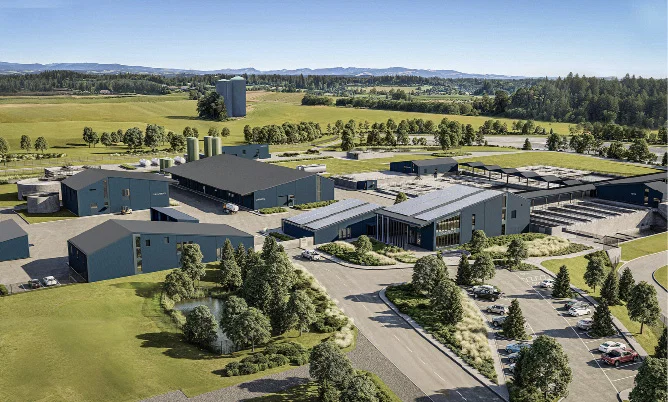
The Bull Run Filtration Facility currently under construction near Portland, Ore., is an excellent example of sustainability-driven decision making. While the project’s primary purpose is to provide safe, reliable drinking water and meet regulatory requirements, the project team used a broader framework to evaluate long-term infrastructure performance. Decisions were examined not only for their ability to achieve treatment objectives, but also for their impacts on resilience, resource efficiency, public health and community value. The resulting project earned Envision Platinum verification and demonstrates how sustainability can function as a project-development process rather than a separate project goal.
A rendering shows the Bull Rull Filtration Facility in Multnomah County, Ore.; Envision Platinum, 2025.
Designed to filter 135 million gallons of water per day, with the ability to expand to 220 million gallons in the future, the facility reflects a focus on adaptability and long-term service life. The project illustrates how infrastructure teams can move beyond asking “Will this solution work?” to also asking “How will this solution perform through time, under changing conditions and for the communities it serves?”
Sustainability in Practice
Looking Beyond Capacity Expansion
The Peña Boulevard Phase 1B Project at Denver International Airport is an excellent example of sustainability functioning as a decision-making process rather than a collection of project features. As the primary access corridor to one of North America’s fastest-growing airports, Peña Boulevard plays a critical role in regional mobility, economic activity and long-term transportation reliability.
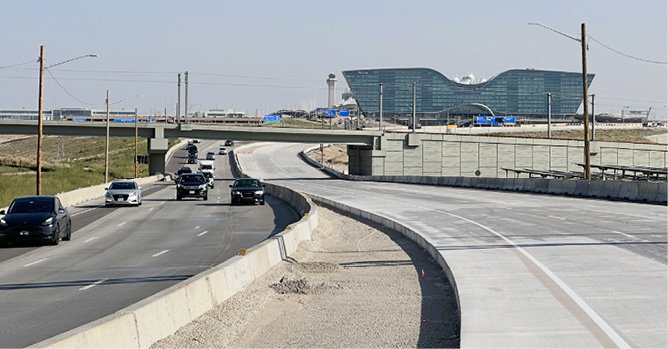
A photo of Denver International Airport, Pena Boulevard Phase 1B, Denver; Envision Silver, 2025.
Faced with growing congestion and increasing demand, the project team looked beyond simply adding capacity and evaluated how the corridor could better support safety, operational performance, multimodal access and future growth. Improvements included roadway enhancements, expanded access for multiple modes of travel and energy-efficient lighting upgrades that reduce long-term operating costs. The resulting Envision Silver verification reflects an approach that considered the corridor’s broader value to travelers, freight movement, airport operations and surrounding communities. The project demonstrates how sustainable transportation infrastructure isn’t defined by individual project features, but by a decision-making process that considers how an asset will perform, adapt and create value throughout its lifecycle.
A Shared Language for Complex Projects
Infrastructure projects today bring together planners, engineers, architects, environmental specialists, contractors, owners, operators, regulators and community stakeholders. Each group views project success through a different lens.
Without a common framework, important conversations can become fragmented. Technical excellence may not fully capture community priorities. Financial considerations may compete with operational goals. Environmental objectives may be evaluated separately from resilience planning.
Creating alignment requires more than collaboration—it requires a shared language.
A common framework enables project teams to establish goals early, evaluate alternatives using consistent criteria and communicate how decisions support broader project objectives. It also provides owners with a transparent way to explain those decisions to governing boards, elected officials, funding agencies and the public.
This transparency becomes increasingly valuable as infrastructure projects grow larger, more interdisciplinary and more visible to the communities they serve.
Measuring What Matters
Infrastructure project teams rely on measurable performance to guide decisions. Yet many of the outcomes that define successful infrastructure—resilience, resource efficiency, ecosystem health, community value and long-term adaptability—can be difficult to evaluate consistently.
Tools such as the Envision framework help address this challenge by organizing sustainability into measurable performance areas that can be considered throughout planning, design and construction as well as for operations and maintenance. Rather than replacing engineering judgment, they provide a structured way to integrate broader project outcomes into the decision-making process.
This holistic perspective encourages project teams to move beyond isolated improvements and consider how individual decisions contribute to the overall performance of an infrastructure system.
The Envision framework is free to use, making it accessible to any project team interested in improving infrastructure performance. The “Envision Guidance Manual,” along with supporting tools and resources, is available through a free account on the ISI website at sustainableinfrastructure.org, providing a practical starting point for teams looking to apply these concepts in real projects.
From Sustainability to Infrastructure Performance
As infrastructure owners face aging assets, growing populations, changing climate conditions and increasing expectations for accountability, project decisions will continue to become more complex.
Meeting those challenges will require more than technical expertise—it will require structured approaches that help teams evaluate competing priorities, manage uncertainty and deliver lasting value.
The Envision framework was developed to support exactly this type of decision-making. Applicable across transportation, water, energy, waste, land development and other civil infrastructure sectors, Envision provides a comprehensive framework for evaluating project performance across environmental, social, economic and resilience outcomes. Rather than prescribing design solutions, it helps project teams make more informed decisions, communicate those decisions clearly and document the value they create.
Ultimately, sustainability shouldn’t be viewed as another project requirement or a final checklist completed before construction begins. It’s a way of thinking about infrastructure performance throughout a project’s lifecycle.
The infrastructure we design today will serve communities for generations. The decisions made during planning and design will determine not only whether those projects meet today’s requirements, but whether they continue delivering value, adapting to change and supporting resilient communities well into the future.
Frameworks such as Envision help bring that broader definition of performance into the project-development process, where better questions can lead to better decisions, documentation and long-term outcomes.
In that sense, sustainable infrastructure isn’t separate from engineering excellence—it’s one way engineering excellence is measured.