

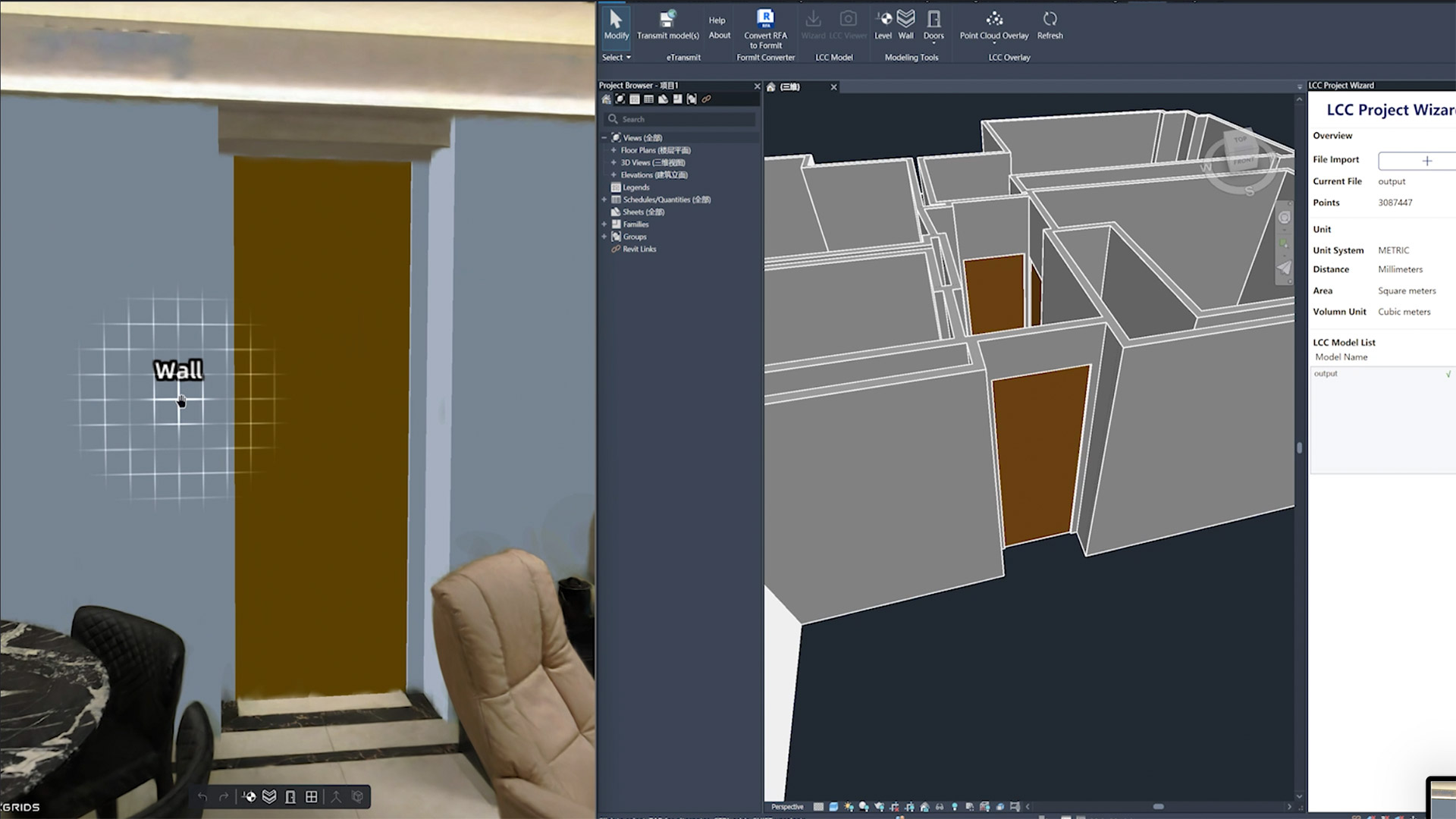
Xgrids LCC for Revit transforms raw scan data into ‘intelligent BIM components’
Xgrids has launched LCC for Revit, a new plug-in that brings SLAM-based 3D Gaussian Splatting technology directly into Autodesk Revit workflows. According to the company, the technology delivers 70-90% efficiency improvements in BIM modelling while maintaining survey-grade accuracy.
LCC stands for Lixel CyberColor (LCC), Xgrids’ proprietary technology which combines LiDAR and visual data with 3D Gaussian Splatting. According to Xgrids, this fusion enables the automated construction of highly realistic 3D spatial models that deliver both photorealistic visualisation and geometric precision.
LCC automatically generates spatial models from single scanning sessions using Xgrids’ integrated spatial cameras. Xgrids explains that with ‘seamless Revit integration’ users achieve real-time alignment between BIM models and LCC spatial models.
Using ‘intelligent AI’ the plugin boasts one-click generation of elements such as walls, doors, and windows. According to Xgrids, this dramatically accelerates the modelling process while maintaining design intent and structural integrity.
“LCC for Revit doesn’t just digitise spaces—it understands them,” explained Mindy Li, Xgrids product manager.
“Our AI recognises spatial elements, structural relationships, and spatial hierarchies, transforming raw scan data into intelligent BIM components.”
AI content is independently produced by the AEC Magazine editorial team.
HP and NVIDIA supports the creation of this content, but all opinions
and coverage remain editorially independent.


Xgrids offers both software and hardware, including the Lixel series of professional scanning devices, LCC Studio software for point cloud processing, LCC for 3DGS modelling, and now LCC for Revit.
Related articles:
