

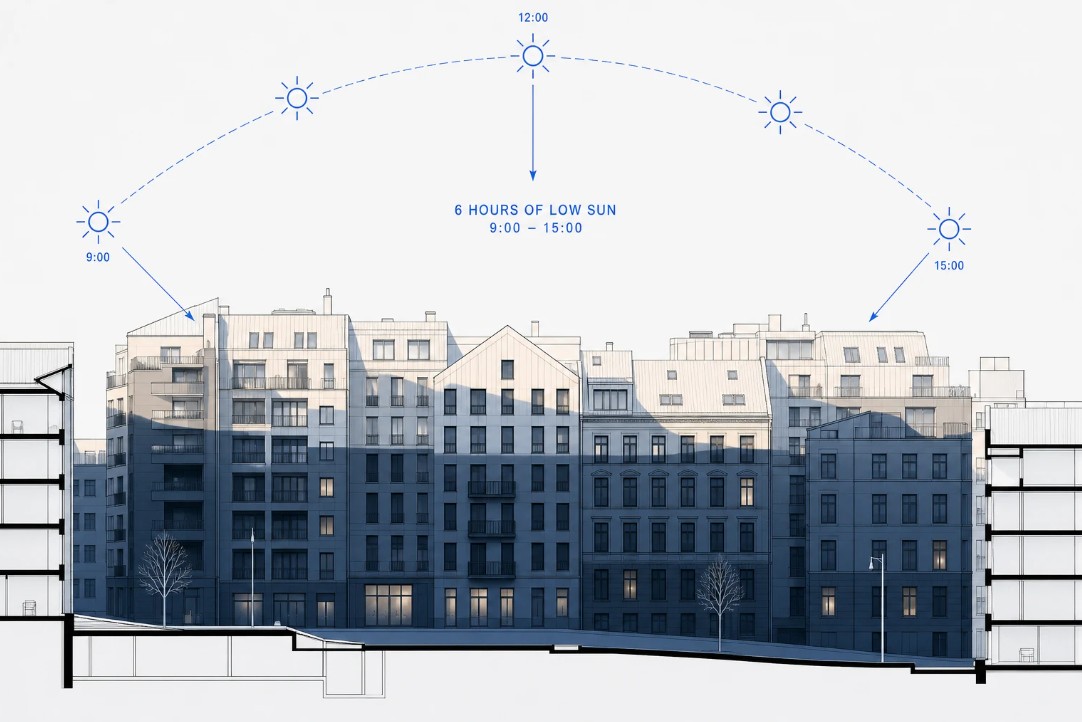
Spacio argues that orientation, spacing, room depth, windows, setbacks, and reflectance should be evaluated early because daylight affects occupant health, comfort, compliance, and building performance.

Daylight is more than an architectural preference. Spacio argues that decisions made during early building design can influence occupants’ sleep, alertness, mood, and cognitive performance. Since people spend most of their time indoors, the amount and timing of daylight entering a building can have meaningful effects on daily light exposure.
Light helps regulate the body’s circadian clock, including sleep and wake cycles. Research cited by Spacio found that office workers near windows slept about 46 minutes longer per night than colleagues in windowless environments. Circadian researchers recommend at least 250 lux of melanopic equivalent daylight illuminance at eye level during daytime for healthy adults, while emphasizing daylight as the preferred source.
For architects, measuring daylight is complicated because regulations and metrics differ. Norway uses daylight factor, while Denmark and European standard EN 17037 incorporate measures reflecting useful daylight over time. Spacio highlights climate-based daylight modeling because it considers actual weather, sun position, orientation, and annual conditions rather than relying solely on a standardized overcast sky.
Metrics such as Daylight Autonomy, spatial Daylight Autonomy, Annual Sun Exposure, and Useful Daylight Illuminance provide different views of performance. UDI is particularly useful because it identifies both insufficient and excessive daylight, including conditions that may cause glare or unwanted solar gain.
A Norwegian project illustrates the difference. Several rooms that failed the conventional 2% daylight-factor benchmark performed substantially better when assessed through annual climate-based simulation. The analysis also identified rooms that genuinely needed design changes.
The article’s main message is that daylight analysis should happen while building massing remains flexible. Orientation, spacing, room depth, window placement, setbacks, and surface reflectance can be difficult or expensive to correct later.
Spacio is bringing these evaluations into early-stage digital design, calculating facade sky exposure, sun hours, solar radiation, and shading while architects develop massing. This shifts daylight analysis from late-stage verification toward an active design input.
