

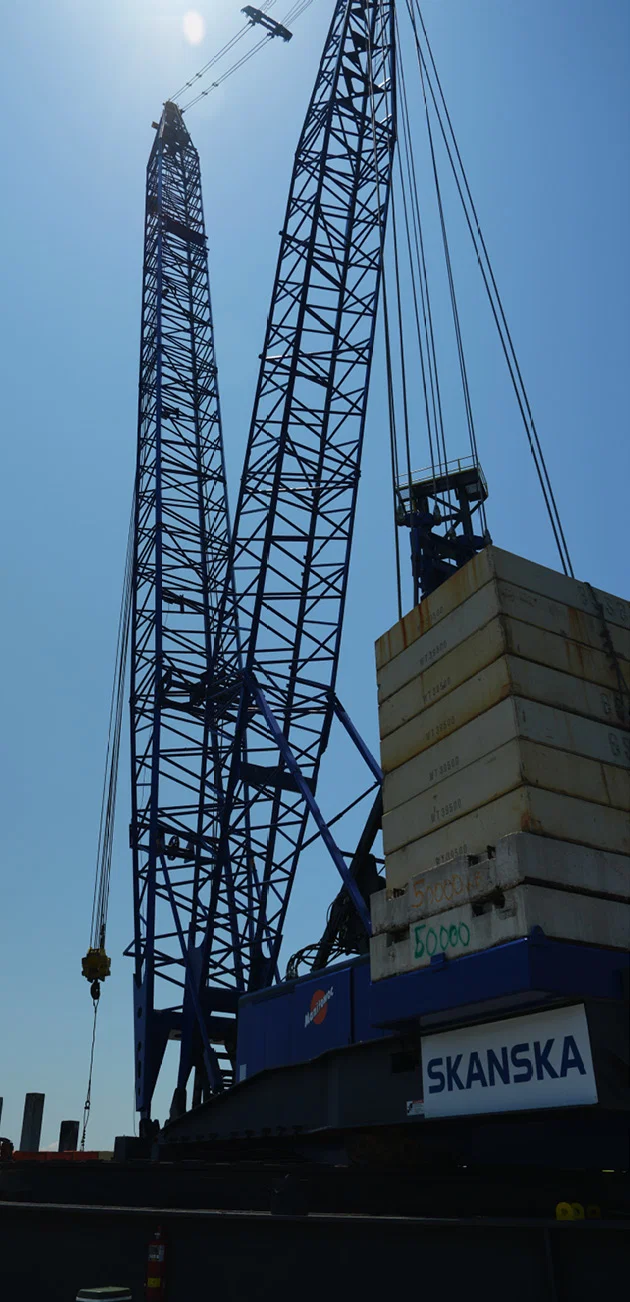
Construction begins on the new bridge spanning the Alligator River in Tyrrell and Dare counties, N.C. A key element is the use of GPS machine control positioning and 3D design technology to support project accuracy. (Leica Geosystems)
North Carolina’s Lindsay C. Warren Bridge has long been a critical part of the local infrastructure, supporting daily traffic and, when needed, the evacuation of residents during hurricanes.
However, the 2.83-mile-long structure, built in 1960, has reached the end of its lifecycle and requires more frequent monitoring, inspection and maintenance to ensure its continued safety and integrity. Given that the region is one of the country’s most hurricane-prone areas, the importance of the bridge across the Alligator River in Tyrrell and Dare counties can’t be overstated.
A massive $450 million project is replacing the existing swing-span bridge with a modern, two-lane, fixed-span high-rise design, located just north of the current bridge, and will include two 12-foot travel lanes with 8-foot breakdown lanes. Three huge barges traversing each carried a large crane and piling rig to support the construction of the new 3.2-mile-long bridge.
With the high-rise section used for boats to pass through, bridge traffic congestion also will be significantly improved, allowing residents to avoid waiting for the swing bridge to open and close.
A Challenging Project
For contractor Skanska, the project presents several challenges due to its length and location, and work also must pause during the fish-spawning season. But unlike the construction of similar bridges, this new structure is already a connected asset, using the latest in GPS machine control positioning from Leica Geosystems, combined with 3D design technology, to support the accurate placement of piles, even at different angles.
For the experienced piling team, adding the new technology improved the accuracy and speed of pile placement, breaking records and allowing the team to stay on schedule. For the project survey manager, Jason Anderson, this dramatically reduced the need for surveyors to support piling teams by traveling to and from the barges, because the system uses GNSS satellite positioning and over-the-air updates from the local GPS mobile network, allowing Anderson and the engineering team to view each rig’s location in real-time.
Speed Never Before Seen
Anderson has more than 20 years of experience working on bridge projects. Despite his experience, he has never seen the speed of piling achieved since the team put the first pile in the ground on Feb. 19, 2025. While using the location technology had a slight learning curve, the team gained more experience and confidence with each pile placed.
“Of course, it all comes down to having some very experienced team members on the rigs as they totally understand how to do this job and how to look after the equipment itself,” says Anderson. “Traditionally, this type of marine piling would demand intensive survey work. Crews would position barges manually, repeatedly resetting anchors and relying on visual cues, which are less accurate. And all this meant time
was lost, which would ultimately increase cost.
“The big difference with the 3D modeling and the way the software integrates with the machine control system is that it’s no longer as survey-intensive as it used to be,” adds Anderson. “Everything is on the tablet, which is mounted on the rig right next to the controls. I am also seeing the same information on my big screens in the office, so we are all working with one version of the truth.”
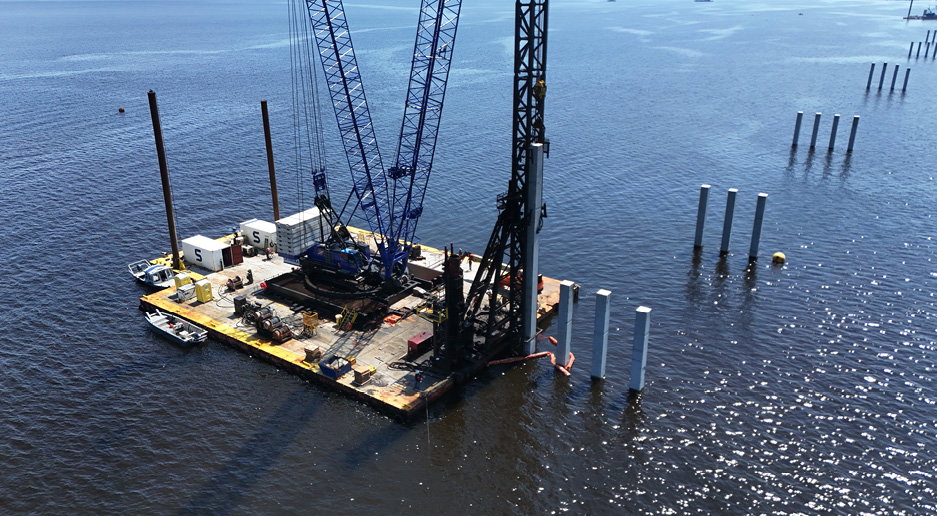
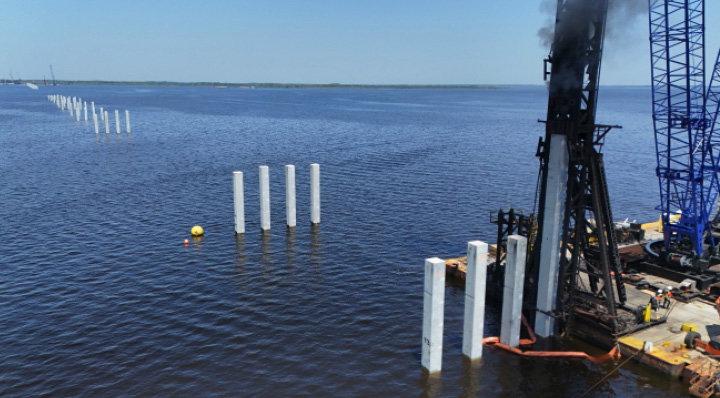
The complicated and delicate piling process is made more accurate by the use of machine control technology that guides positioning barges, accurately positions the pilings at the proper angles and improves overall visualization. (Leica Geosystems)
The Piling Process
The piling process begins with using the tablet to position the barge in the correct location. The team then puts out the anchors to secure it to the riverbed, and, using the tablet, they adjust the lines to fine-tune the barge positioning.
“Once the barge is in the right place, the tablet is then used as a guide to position the piles and get the right angles for their placement,” explains Anderson. “All this is done in real-time and monitored by the piling team and me before the piles are driven in.
“What is key to the success of this approach is the visualization that comes with using the tablet, as the crews see precise pile positions overlaid on the screen,” he adds. “For this project in particular, we need a high level of accuracy as the piles are driven into muddy ground without a rock base.”
Using the machine control technology also helps overcome environmental constraints. As the bridge is located within a protected national reserve, piling must stop for several months each year during fish-spawning season.
“Because we knew we were going to lose a couple of months in the summer, we put on a big push to drive as many piles as possible before the July 15 moratorium,” notes Anderson. “This allowed us to stay on program and use the time to prepare for the next push.”
The technology isn’t just about the hardware fitted to the rigs—it’s also about how the team uses its Leica ConX cloud platform to manage data from the site. Team members, project managers and clients can access real-time progress data and model updates, regardless of their location.
“On a job like this, you can’t just drive back to the office, as all the action is on the water, and it takes some time to get out to each rig,” details Anderson. “With ConX, crews can download the latest model to the tablet and upload information from the barge.”
Similarly, if the team needs support from Leica, it can grant one of Leica’s experts access to the tablet for troubleshooting.
“This was very helpful, in particular when we were getting used to the system, as most things are quick fixes or can be talked through. And it now gives us a competitive advantage when tendering for other projects, as we know what can be achieved, and we have already gone through the learning-curve process.”
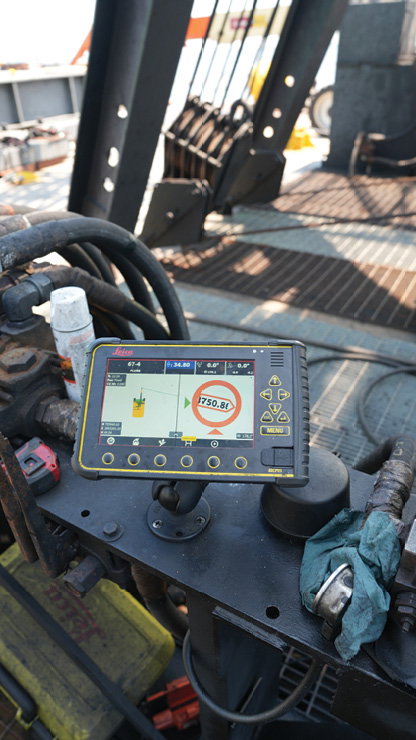
A rig-mounted tablet provides access to the same information seen on big screens in the office, creating a high-functioning environment where all involved are working with the same version of facts. (Leica Geosystems)
No More Manual Processes
Superintendent Luke Eason has more than 25 years’ experience in piling both on the ground and on the water. In the past, teams relied heavily on surveyors with total stations to shoot in piles. Now they’ve eliminated that process by training supervisors and other operators directly on the system, and the work is much faster and more efficient.
“For example, we can now drive three to four piles a day, compared with just one or two under traditional methods,” he adds. “The difference is particularly significant when working in challenging environments.
“Of course, some days you will have great calm weather and others it can be more choppy, so if the water’s rough, the rig can shift back and forth by about an inch or two,” notes Eason. “But we can work around that to keep the numbers right so we’re hitting the piles within the defined tolerances.”
For Eason, the progress of using technology is part of a broader trend he has witnessed throughout his career.
“When I started 25 years ago, everything was manual,” explains Eason. “Every year since then, technology has continued to evolve. It’s a whole lot better now than it was when I started out.”
People Remain Central
Despite these advances, Eason stresses that people remain central to successful piling operations.
“Experienced operators and committed teams bring the skills and judgment needed to apply technology in real-world conditions, so the support and training we benefited from were critical to rolling out this approach,” he says.
Central to the project’s success is its “Super Rig,” formed of three barges joined together, carrying a Triple 8 ringer crane with incredible lifting power.
The barge system gives the team the stability it needs to handle enormous loads. That capacity is vital when dealing with the project’s main piles, which range from 89 to 125 feet in length and weigh up to 143,000 pounds.
“When you are ready to put in a pile, the process begins with what we call the driving cap,” explains Preston Harris, piling team member. “It’s a 10,400-pound block of metal that transfers the hammer’s force onto each pile.
“Between the hammer and cap sit cushion blocks, which absorb shock and protect the pile head,” he adds. “Right now, we’re using 18 inches of cushion block. We’ll change them out roughly every 800 to 900 blows. To prepare the pile, we first use the fixed crane to support the lifting of piles from smaller barges onto the platform and then into the rig itself.”
The crane also is used to lift and place the anchors into position when moving to the next location. After piles are positioned, the hammer stand and A-frame guides secure them before driving begins.
“You’ve then got a spotter looking at the tablet while talking to the anchor operators on radios,” notes Harris. “The anchors and spuds hold us in place, securing the barge against horizontal movement while providing vertical stability. And the tablet dictates where everything needs to be.”
The system displays both toe and head positioning of each pile, with operators adjusting until both align “in the green.” This ensures that even angled batter piles are installed correctly.
Done Right Every Time
With machine control guiding alignment, the North Carolina Department of Transportation oversees quality by monitoring blow counts as piles are driven. When a pile meets depth and resistance criteria, operators switch cushions or reposition for the next cycle.
“Everything is in this computer to get those piles exactly where they need to be,” says Harris. “For us guys on the rig, it feels like working on dry land, even though we’re out here on the water.
“There are two different types of piles, with the circular piles core to the main section of the bridge, which is the hump that allows vessels to pass beneath,” he explains. “It’s critical we get it right.”
The team has demonstrated that by combining experience with the proven precision of machine control technology and the raw power of heavy equipment, projects such as this can be delivered more safely and efficiently.