

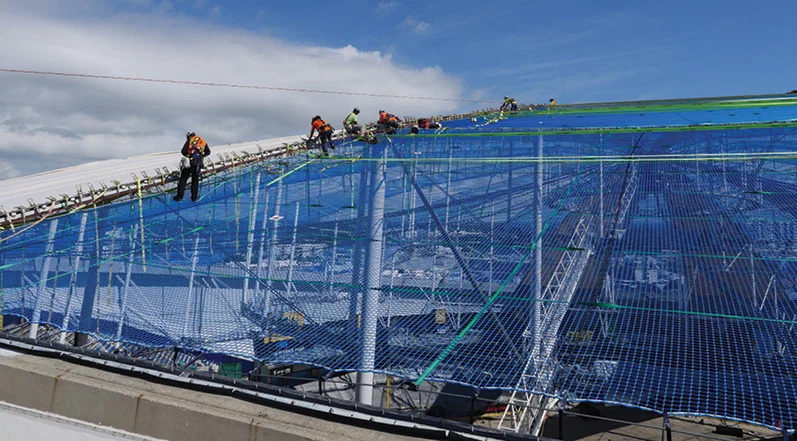
(Image: Gieger Engineers)
Hurricane Milton ravished Florida’s Gulf Coast in 2004, a deafening reminder of the increasing risks facing large-scale structures in a warming climate. Home to the Tampa Bay Rays Major League Baseball (MLB) team, Tropicana Field is well known as one of the largest tensioned-fabric cable domes in the world. Milton produced winds exceeding 100 mph that enacted catastrophic membrane failure when 18 of Tropicana Field’s 24 polytetrafluoroethylene (PTFE)-coated fiberglass roof panels were ripped apart during the weather event.
Fortunately, the primary structural system, a 210-meter-diameter Geiger cable dome constructed in the late 1980s, withstood the elements and remained almost completely intact. With looming time constraints to restore the stadium and return it as a viable and functioning community structure, the dome’s survival formed the foundation for a complex roof-rehabilitation project.
David M. Campbell, P.E., principal at Geiger Engineers, the engineer of record for the original dome and its 2025-2026 reconstruction, led the roof-rehabilitation project, which demanded efficient decision-making, strong structural expertise and a forward-looking approach to climate resilience.
With a future being defined by stronger storms, increased impact of higher rainfall and evolving building codes to meet these changes, the project considered how to prop Tropicana Field up for future survival while preserving a long-span structure and getting it back in business in the most efficient and cost-effective way possible.
Approaching Structural Design
When addressing concerns of rising climate extremes, performance requirements of the roofing solution proved critical, and a modern tensioned fabric roof was no different.
According to Campbell, the baseline criteria were mandated by the City of St. Petersburg’s Building Department, which stipulated the new roof must meet all aspects of Florida’s current building code. The Geiger engineering team went to work and capitalized on a unique advantage: By analyzing Tropicana Field post-Milton, they gained detailed understanding of how the original structure responded to extreme wind loading. The team performed a full structural assessment and tallied its findings.
“Initial inspections revealed that the primary cable dome remained intact and serviceable,” says Campbell.
According to the assessment, no significant distress or permanent deformation was discovered in the radial ridge cables, diagonal cables, hoop tension rings, flying struts or concrete compression ring. The only notable structural damage was due to ponding at cable anchorages that caused them to fail, creating secondary impacts when detached cables struck adjacent components during wind loading. After compiling data, initial inspection revealed the original Geiger cable dome remained intact after 35 years of service.
Geiger Engineers considered alternative membrane materials for the roof rehabilitation but selected the same PTFE-coated fiberglass material as the original roof. Several reasons influenced the decision, including its ability to meet strict fire-resistance requirements, a proven service life of 25 years or more, its predictable structural behavior under tension, and because it easily met the building code without needing time-consuming variances.
“The tension membrane is very flexible, and the supporting primary structure is quite flexible,” explains Campbell. “As a consequence, the fabric is relatively insensitive to thermal expansion and contraction, which changes membrane stresses. As with building structures in general (as opposed to bridge structures), fatigue was not an explicit quantitative design consideration.”
According to Campbell, Tropicana Field’s new roof membrane maintains the same load paths and structural response as the original, with the membrane tensioned between ridge cables, valley cables and the perimeter compression ring. Such continuity allowed engineers to take advantage of decades of performance data while also utilizing modern analysis tools.
One of the most consequential engineering decisions linked to the project is rooted in reliance upon the original 1985 boundary layer wind study to determine design wind pressures. The study produced winds speeds that exceeded current code requirements when converted to modern ASCE 7-22 equivalents. With the push to return Tropicana Field to life, this finding enabled the Geiger Engineers team to avoid costly and time-consuming strengthening of the primary cable dome.
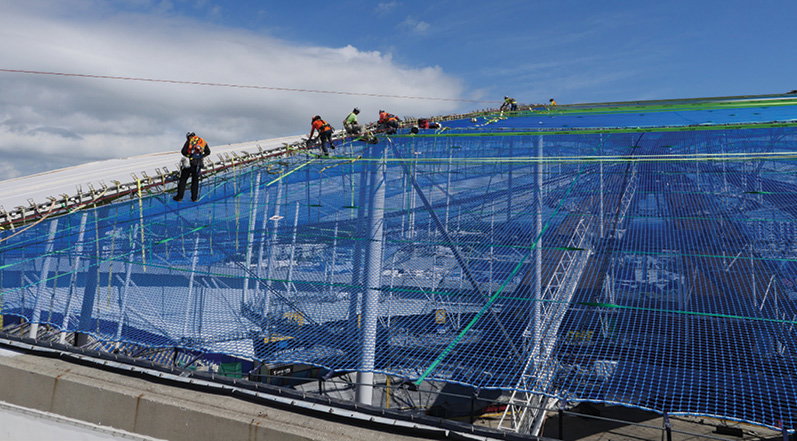
Installation crews pull a new fabric panel to the ridge cable to be clamped. (Geiger Engineers)
Mitigating Wind and Severe Weather
Aging tensile membrane systems often show signs of vulnerability. Membrane panels can become brittle during extended periods of UV exposure, and tear strength can greatly decrease. Hurricane Milton exposed some of these vulnerabilities within the Tropicana Field roofing system.
According to Campbell, the primary failure was tear propagation under high-tensile stresses. When a tear initiated, sustained winds caused rapid expansion within the individual panels. As a result, adjacent panels impacted by abnormal warp stresses were compromised.
Geiger Engineers’ new roof system addresses water intrusion through fully sealed closures and field-sealed joints. To date, no post-installation callbacks have been reported.
The new Geiger Engineers’ solution also considered debris impact resistance. To satisfy Florida’s code requirements, the new membrane successfully passed ASTM E1886 and TAS 201/202 small-missile impact testing.
While roof installation progressed, Geiger’s engineering team analyzed the structure at each stage to ensure stability was maintained under construction wind loads. Temporary circumferential cable ties were utilized to prevent excess inward movement of the partially installed panels; a process developed directly from analyzing how the panels behaved during the storm.
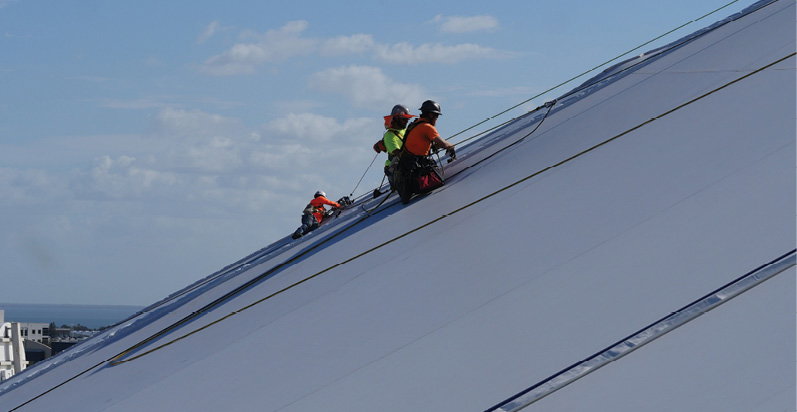
Workers donning fall-protection equipment work to seal a ridge clamp closure strip. (Geiger Engineers)
Climate Change Demanding Long-Term Resilience
Climate change resiliency is a growing consideration in engineering solutions. Tropicana Field’s reroof project serves as an example of how engineers must adapt to a world where historical climate data no longer guarantee a structure’s future performance in dealing with excessive rain, warming temperatures and increased wind speeds.
For the Tropicana Field project, the original wind-tunnel study, which was based on local and site-specific meteorological data, produced wind speeds exceeding those specified in today’s ASCE 7. According to Campbell, modern code wind speeds rely on regional datasets that could potentially fail to capture local extremes.
“The windspeed determined in the 1980s from local climate data resulted in a higher design wind speed than current code, which is presumably developed from more-recent climate data,” notes Campbell. “Likely this is a result of the site-specific nature of the data used in determination of the original wind study as opposed to regional data being employed to develop the design wind events in the code.”
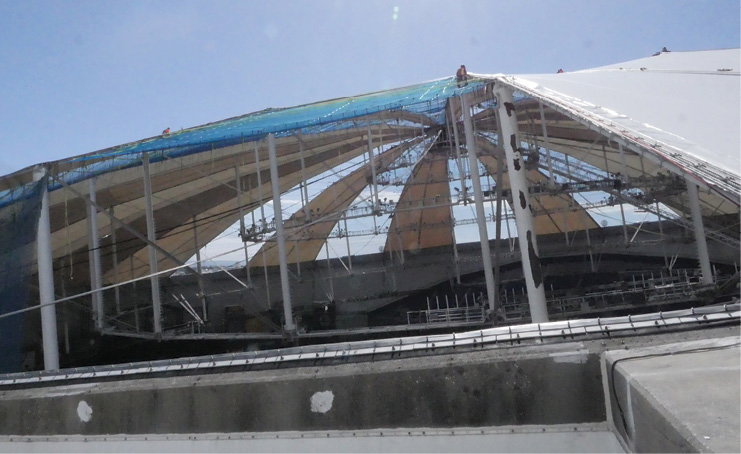
Once pulled to the new location, the installation crew clamps a new membrane panel to the ridge cable. (Gieger Engineers)
Managing Compliance and Codes
During design, Geiger Engineers considered multiple code and compliance agencies, including the Florida building code, ASCE 7, ASCE 55 and local wind-borne debris regional requirements. According to Campbell, the team met threshold inspection requirements specified in Florida’s building code and participated in peer reviews required by engineers representing MLB and the Tampa Bay Rays organization. In addition, the team submitted compliance verification with ASCE 7 wind provisions.
Geiger Engineers performed detailed conversions to demonstrate equivalency to ensure the structure would meet or exceed current requirements. This proved to be a technically challenging process in reconciling the 1980s fastest-mile wind speed methodology with the modern three-second gust standards of today.
Assuring Quality During Construction
Reinstallation of a tensioned membrane on a 210-meter cable dome is a monumental task, a logistical and engineering feat requiring specialized cranes and rigging implemented by highly trained professionals. It’s a project that demands real-time structural monitoring with the implementation of sequential tensioning analysis while relying on temporary stabilization systems.
According to Campbell, the team debated whether to retain the six surviving panels that still stood after Milton but decided to remove them because of their altered stress state; a loss of prestress allowed uncertainty to surface even when considering moderate wind-loading affects.
Each of the roof panels was installed and tensioned in a sequential process. Engineers analyzed the structure at each stage using ASCE 7 and ASCE 37 wind loads. Temporary circumferential cable ties helped control fabric deformation as well as prevent excessive warp stresses. Understanding hurricane failure sequence proved invaluable in this process.
Geiger Engineers called upon a reverse-sequence analytical model when performing final tensioning of the roof structure. This involves progressive management of relaxing and re-tensioning cable to achieve prestress uniformity. During this process, some cables required initial jacking forces exceeding their final values to achieve correct distribution.
To successfully perform the process, Campbell gives merit to the onsite engineering oversight performed by his firm, in addition to the quality-control and guidance program of installer ETS. Threshold inspection along with continuous coordination among structural engineers, fabricators and the design-build contractor team all played critical roles in navigating a successful completion to the reroof project.
Gaging Lifecycle Performance
Tropicana Field’s new roof was designed with certain principles in mind, including durability, maintainability and long-term performance while climate conditions continue to evolve. PTFE-coated fiberglass carries a well-documented series of maintenance points that include periodic cleaning, inspection of clamps and fastening systems, monitoring of valley cable tension, and sealant checks at closure points.
“The maintenance regimes for PTFE-coated fiberglass tensioned membrane structures are quite well developed and documented,” adds Campbell.
While energy performance didn’t reign as a new roof factor, watertightness, material durability and structural reliability remain top considerations to ensure stable operations for long time periods. Although no explicit climate-adaption features were added to Tropicana Field’s new roof, the structure’s inherent flexibility, robust primary system and high wind-load capacity provide an avenue for future retrofit and upgrades if needed.
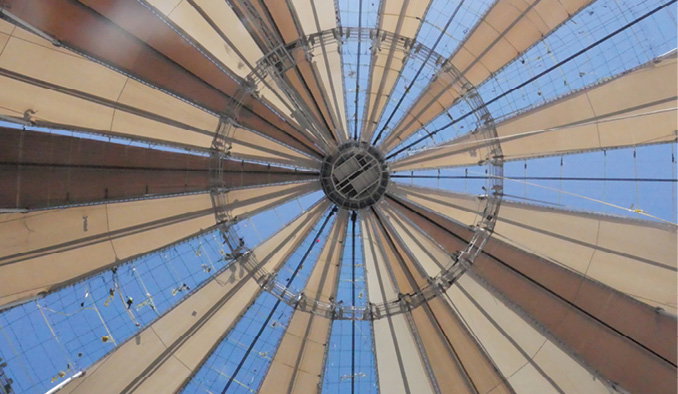
Looking from the ground up to the dome’s center, 17 deployed roof panels can be seen with the shade of panel showing the sequence. Panels bleach white with sun exposure, while dark panels represent those recently deployed. (Geiger Engineers)
Recognition in a New Climate Reality
While it might seem a repair project to some—or just another day in the world of construction—the Tropicana Field reroof project could be considered a blueprint for the innovative approach needed to develop engineering solutions that approach resilience in an era of climate extremes. Successful completion of Tropicana Field’s reroof project demonstrates unarguable certainties.
Tear-down solutions don’t reign as exclusive answers to aging structures, as the Tropicana Field project proves they can be rehabilitated to modern standards. In addition, site-specific wind data remain an invaluable source of information.
When referencing the Geiger reroof design, specific construction material use and practices provide their own level of certainties. Tensioned membrane systems require nuanced understanding of failure modes while construction sequencing is just as critical as final design.
Campbell identifies critical lessons that surfaced from this project. Future assessment, rehabilitation and resilience planning of tensile membrane structures succumbing to age and extreme environmental hazards are all areas of paramount importance demanding consideration. In a world of rising wind loads, intensified precipitation patterns and climate uncertainty, Tropicana Field towers as a testament to the power and effect of engineering ingenuity. Resilience is no longer a luxury, but instead a necessity.