

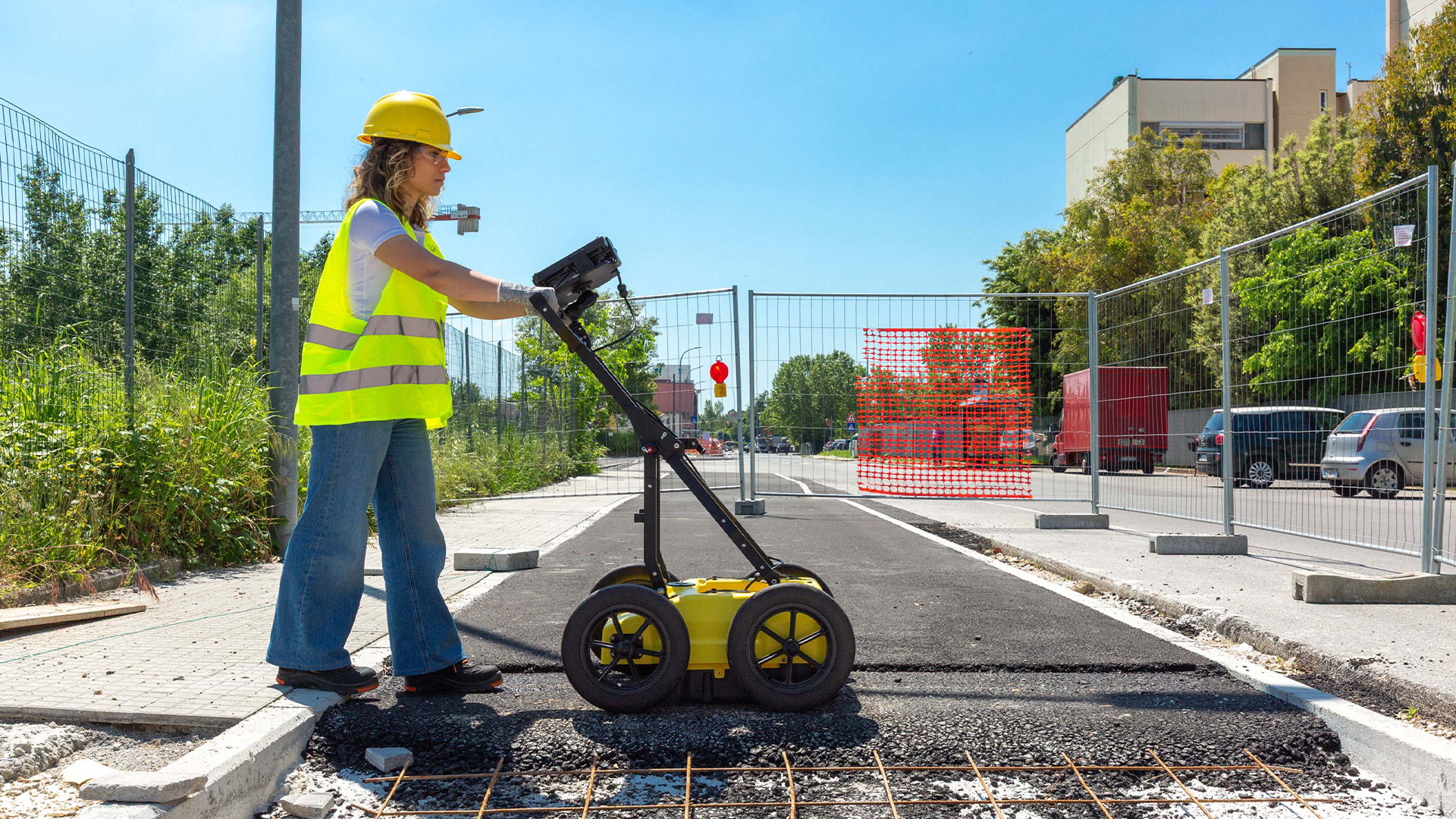
The new Leica DS4000 utility detection system reportedly enables construction, utilities, and surveying professionals to see more and reach deeper
As the network of cables and pipes grow more congested in urban spaces, underground detection systems have become more important for reducing risk before breaking ground.
Leica Geosystems reports that its new Leica DS4000 utility detection system identifies underground assets up to 60% deeper than traditional detection methods.
By incorporating IDS GeoRadar’s patented Equalised Scrambling Technology (EsT), the four-wheeled unit is said to provide clearer detection of underground utilities at both shallow and greater depths, even revealing smaller objects that might have been missed previously, such as fibre optic cables.
“The DS4000 helps teams work more efficiently, confidently, and safely. With increasing emphasis on safety, tighter regulations, and more complex projects, precise underground utility detection is becoming even more critical,” says Matthias Twardzik, director Hexagon detection at Hexagon’s Geosystems division.
“With the DS4000, surveyors can deliver accurate data in complex environments, and construction or utilities teams can reduce risk, avoid costly setbacks during excavation, and keep their timelines on track.”
According to Leica Geosystems, the DS4000 is lightweight, portable and easy and safe for a single person to transport and operate. The wheels can be quickly swapped out, enabling one user to tackle both flat surfaces and rough terrain.
In addition, the antenna, which extends below the cart, is mounted on an automatic height-adjusting system that lowers it for detection and raises it to avoid obstacles, reducing the risk of damage.
Related articles:
