

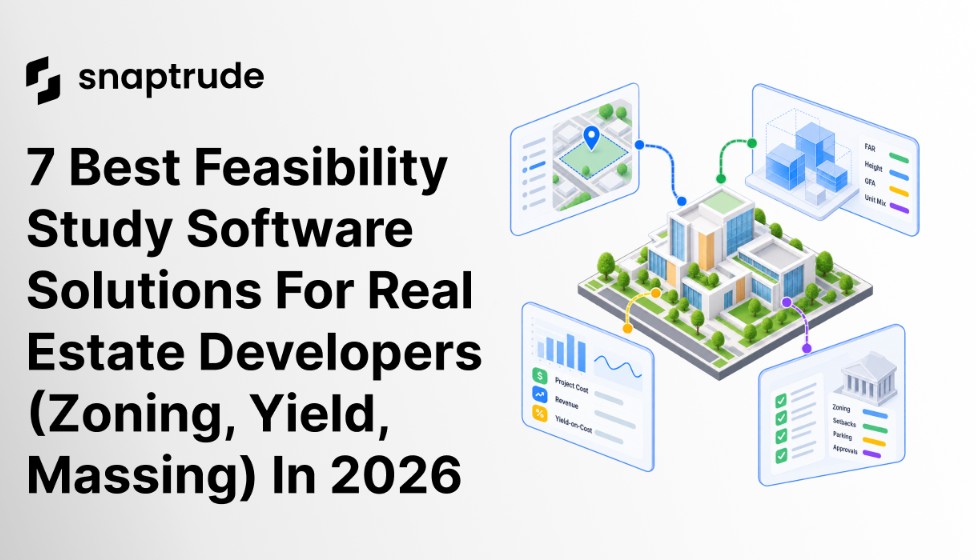
From zoning analysis and building massing to parking optimization and financial forecasting, seven software platforms help developers evaluate project viability before committing to construction.

Real estate feasibility studies help developers determine whether a proposed project is financially viable and technically achievable. However, traditional assessments involving zoning regulations, building massing, parking requirements, and construction costs can take weeks and cost thousands of dollars. AI-powered software is accelerating these processes while improving early-stage decision-making.
This Snaptrude article compares seven feasibility study platforms: Snaptrude, TestFit, Deepblocks, ArchiWise AI, Digital Blue Foam, Higharc, and Northspyre. Each addresses different aspects of real estate development, from site selection and design optimization to financial planning.
Snaptrude combines AI-assisted zoning analysis, three-dimensional massing, and building information modeling (BIM). Its Universal Agent interprets setbacks, height restrictions, and floor area ratios to generate preliminary building envelopes. Developers can track floor areas, unit counts, and parking requirements as designs evolve. The resulting model can continue into architectural development.
TestFit specializes in generative site planning, parking layouts, and development yield optimization. Deepblocks analyzes zoning regulations, market conditions, and financial projections across hundreds of U.S. cities, helping developers identify promising properties.
ArchiWise AI supports early site screening by combining parcel information, zoning requirements, and financial feasibility assessments. Digital Blue Foam integrates environmental considerations, including carbon emissions, energy performance, wind, and solar exposure, into building massing studies.
Higharc focuses on residential development, connecting home design with construction estimates, code checks, and permit documentation. Northspyre addresses financial management through budgeting, cost forecasting, and project tracking.
Despite these capabilities, AI-generated feasibility assessments require professional verification. Zoning interpretations, development assumptions, and financial projections must remain transparent, editable, and traceable.
The article emphasizes that software selection should reflect project requirements rather than feature counts. Developers evaluating multiple properties may prioritize automated screening, while architects need tools that connect feasibility studies with detailed design.
Ultimately, AI can accelerate feasibility analysis, but professional judgment remains essential for evaluating development risks and ensuring projects are practical and financially sound.
