

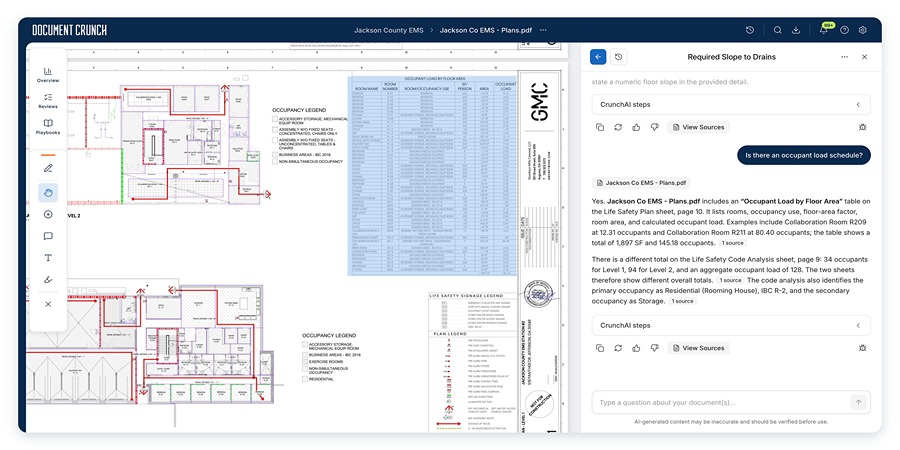
CrunchAI searches drawing text alongside contracts and specifications to identify scope gaps and conflicting requirements.

WESTMINSTER, CO, Oct 26, 2026 – Document Crunch has expanded its construction document review software to analyze text from drawings alongside contracts, specifications and other project documents. The new capabilities use CrunchAI to search and query document sets simultaneously for scope gaps, conflicting requirements and potential risks.
“Construction teams work across hundreds of drawing sheets, specifications, contracts and other project documents, and significant risks emerge when information across these documents doesn’t align,” said Josh Levy, co-founder of Document Crunch and vice president of risk and compliance solutions at Trimble. “Accelerating this review process with AI provides preconstruction teams a comprehensive view of project requirements, allowing them to identify conflicts and scope gaps while there is still time to clarify, price or resolve them before they become rework, unplanned cost or disputes.”
CrunchAI extracts and indexes text from construction drawing sets, including notes, allowances and language defining the scope of work across hundreds of sheets. Teams can use a chat interface to ask questions across drawings, contracts and specifications, then verify answers through notes linked to source documents.
The CrunchAI technology combines proprietary pre-processing and post-processing with agentic optimization to produce answers for construction workflows. Within a shared project environment, teams can collaborate on identified issues, track work and monitor how risks are being addressed. They can incorporate findings into repeatable reviews and assign follow-up and resolution workflows.
The new drawing review capabilities support:
- Bid document checks: Automatically verify sheet indexes, identify missing drawing sheets or specification sections, and flag discrepancies between disciplines and potential issues.
- Cross-document review: Identify conflicting requirements, scope gaps and unclear responsibilities across drawings, contracts and specifications.
- Standardized preconstruction reviews: Apply the same company checks across drawing sets and related documents so teams review requirements and risks consistently.
- Pre-award clarification: Use findings to resolve requirements and scope questions before award.
“On a recent renovation project, we had to redo some plumbing, but the drawings didn’t show that we would also need to cut concrete and backfill,” said Kristen Ortiz, vice president of project controls at Hill & Wilkinson. “Document Crunch caught those additional requirements, helping our team identify work that might otherwise have been overlooked.”
Construction drawing review is now available to all users within their existing Document Crunch workflows.
Source: Trimble
About Trimble

Trimble Inc., established in 1978, is a technology company focused on creating tools that connect the physical and digital worlds. Based in Westminster, CO, the company serves industries such as agriculture, construction, geospatial technology, and transportation. Its products include GNSS receivers, optical devices, machine control systems, and widely used software and services. Trimble’s construction technology improves project efficiency by using data throughout each build stage. The company employs around 12,000 people worldwide. The company prioritizes innovation and sustainability, working to make industries productive, safer, and environmentally friendly.
About Document Crunch

Document Crunch develops AI software that reviews construction contracts and project documents. Founded in 2019, the Trimble company is headquartered in Alpharetta, GA. Its customers include general contractors, trade contractors, designers, project owners and insurers. CrunchAI identifies contractual risks and answers questions with references to source documents. Project Assist analyzes related documents, identifies gaps in project responsibilities and drafts notices and requests for information. Users can compare document versions, review changes, check obligations and track decisions from bidding through project completion.
