

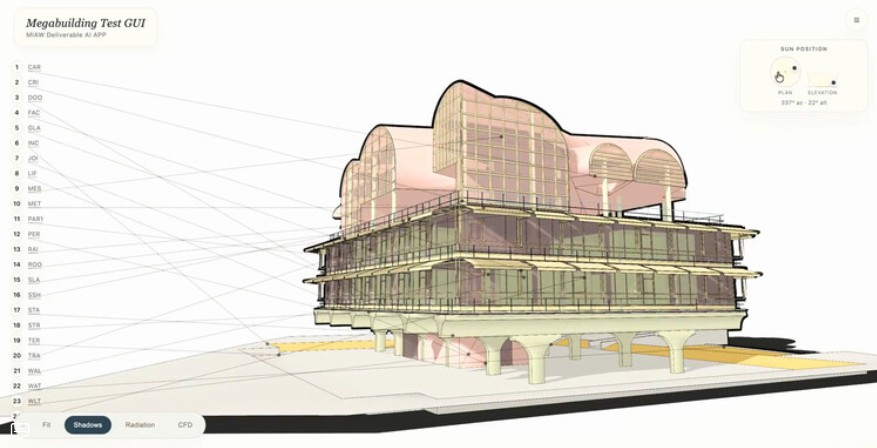
From language models to world models, artificial intelligence is helping architects understand physical environments, predict building performance, and make more informed design decisions.

Artificial intelligence is changing architecture by introducing spatial intelligence, enabling architects to understand and simulate how physical environments behave. Rather than relying solely on conventional design methods, architects can use AI to evaluate environmental conditions, anticipate building performance, and make informed decisions throughout the design process, tells Arch Daily.
The article highlights the transition from large language models (LLMs) to world models. While LLMs generate responses based on patterns in text, world models attempt to understand physical laws, spatial relationships, and environmental dynamics. This distinction is particularly important for architecture, where buildings must respond to real-world conditions.
Spatial AI allows architects to simulate factors such as gravity, wind, sunlight, thermal diffusion, moisture absorption, pollutant dispersion, and human movement. By incorporating these simulations into design workflows, professionals can evaluate potential outcomes before construction begins. This approach encourages designs that respond to environmental complexity rather than simply imposing predetermined architectural forms.
The article also examines technology’s influence on human development. As AI accelerates technological change, architects must develop new skills that combine design expertise with computational engineering, materials science, and simulation technologies. The emphasis shifts from creating architectural forms to developing knowledge-driven systems capable of predicting design consequences.
However, AI cannot replace professional judgment. Simulations provide valuable information, but architects remain responsible for interpreting results, evaluating trade-offs, and making decisions that consider human needs and environmental consequences.
The Mindhub for Intelligent Artificial Worlds (MIAWS), based at the Universidad Politécnica de Madrid’s School of Architecture, supports this transition through research, collaboration, and education. Its online Foundations program introduces AI modeling, simulation, data visualization, and integration across 10 modules.
Ultimately, spatial AI presents an opportunity to strengthen architectural practice by connecting computational intelligence with physical reality. Its greatest value lies not in automating creativity but in helping architects understand complex environments and design buildings that respond intelligently to them.